
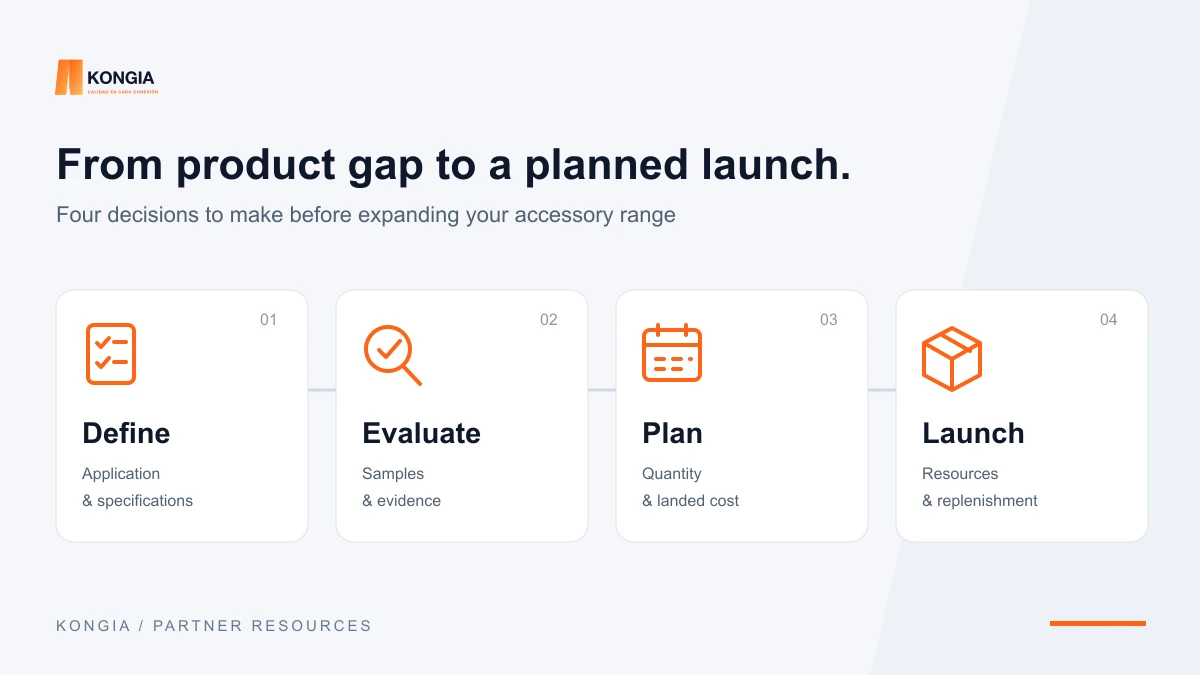
At a glance. Evaluate an accessory supplier against five needs: application fit, repeatable product requirements, practical order quantities, replenishment and launch support. Compare the complete purchasing decision, not the unit price alone.
Begin with a product gap, not a long price list
Before requesting quotations, identify the problem you want to solve. Are installers asking for accessories you do not stock? Do existing factory minimums make a new category difficult to test? Is your team spending too much time coordinating specifications and pictures across suppliers?
Choose a small set of products connected to a real customer need. Record the current alternative, expected use, sales unit and likely order frequency. This makes the first comparison manageable and prevents an apparently attractive catalogue from becoming an unfocused inventory commitment.
1. Specify the application before choosing a model
Names such as RJ45 connector, fiber patch cord or rack PDU cover many configurations. A category label is a starting point, not a complete purchasing specification. Ask which cable, equipment, installation space and working conditions the product must support.
For a copper connection, confirm category, shielding, cable construction and the termination or mating arrangement. For a fiber link, record fiber type, connector and polish, the equipment at both ends and the required link design. For rack accessories, check the mounting format, depth and the relevant physical or electrical requirements.
| Category | Questions to resolve before ordering |
|---|---|
| RJ45 and copper accessories | Which cable and connector format? Which shielding and termination method? Which sales unit? |
| Fiber connectivity | Which fiber, connector and polish? Which endpoint equipment and optical requirements? |
| Rack accessories | Which rack size, mounting method, depth and load or electrical requirements? |
| CCTV installation products | Which camera interface, power arrangement, enclosure and mounting conditions? |
2. Turn sample approval into a written reference
Samples are most useful when there is a defined basis for evaluation. Record the exact SKU, configuration and supplied documents. Agree which physical details and functions will be checked, which equipment will be used and what an acceptable result looks like for that application.
Keep the approved sample record with the order specification. Ask how material, component or construction changes will be communicated and how a repeat order will be checked against the agreed reference. A successful sample evaluation should inform later purchasing, not remain an informal impression held by one person.
Do not treat a product photograph or a broad compliance statement as proof of a test result. Request the relevant documentation for the exact model and intended market. Where a project specifies a certified system, check the system requirements before substituting individual components.
3. Compare MOQ with the real inventory commitment
An OEM quotation and a standard branded-product quotation may offer different trade-offs. OEM can support your own brand identity, but product and packaging minimums can require a larger first commitment. A standard product can offer a more practical way to explore an unfamiliar category.
At KONGIA, approved partners can order standard branded products without an MOQ, subject to each item’s sales unit. OEM minimums are confirmed separately. In either case, calculate the cash tied up in the proposed mix, the time needed to sell it and the cost of replenishment.
A lower FOB price is not automatically a lower delivered cost. Use a consistent comparison that includes the product specification, order quantity, packing, freight, applicable import costs and destination handling. Ask a logistics provider or customs adviser for market-specific figures rather than assuming that a percentage from another shipment will apply.
4. Plan the second order before placing the first
The first shipment validates an opportunity; repeat availability makes it a useful category. Before committing, ask which products are available for the proposed order, which require production and how lead times will be confirmed. Discuss replacement models and notice of product changes.
Agree how shortages, transit damage or a product issue will be reported. A clear record of SKU, order, batch information where available, photos and symptoms helps both teams investigate. Confirm warranty duration and responsibilities for the selected products; a headline warranty period alone does not explain the claim process.
5. Prepare the information your sales team needs
A product may be physically ready to ship while its local listing is not ready to publish. Before launch, collect a consistent product name, SKU, key selection information, images, sales unit and relevant documents. Confirm which materials are available in the language used by your customers.
KONGIA’s catalogue and partner tools support product comparison and access to available partner pricing. Spanish-language brand assets support Latin American launches; English-speaking markets should confirm the required English resources for their chosen range. The aim is to reduce repeated content preparation while keeping each listing accurate.
Use a short supplier-review checklist
A useful review can fit on one page. Record each answer and the supporting document rather than relying on an overall impression of the supplier. Unanswered items become the agenda for the next conversation.
- Define the intended application and exact product configuration.
- Request specifications, sales units and relevant product documentation.
- Evaluate samples against an agreed checklist.
- Compare first-order and replenishment costs on the same basis.
- Confirm launch materials, warranty handling and product-change communication.
Related KONGIA products
Questions before ordering
Should a distributor begin with the whole product range?
A focused set of products is easier to assess. Start with identified customer needs and expand after evaluating specifications, samples and actual demand.
Does no MOQ remove the need to plan shipment size?
No. Sales units still apply, and freight and import costs influence the economics of a small shipment. Plan a mix that works for your market.
What should accompany a sample request?
Include the intended application, exact configuration, expected quantity and the checks or documentation required for approval.
Sources and scope
This article describes KONGIA’s own product approach and partner offer. Company and team information is supplied by KONGIA; it is not an independent audit or third-party endorsement. Product-specific documentation and the agreed quotation govern specifications, availability and commercial terms.
- KONGIA — Company and product systems
- KONGIA — Partner program
- KONGIA — Product catalogue
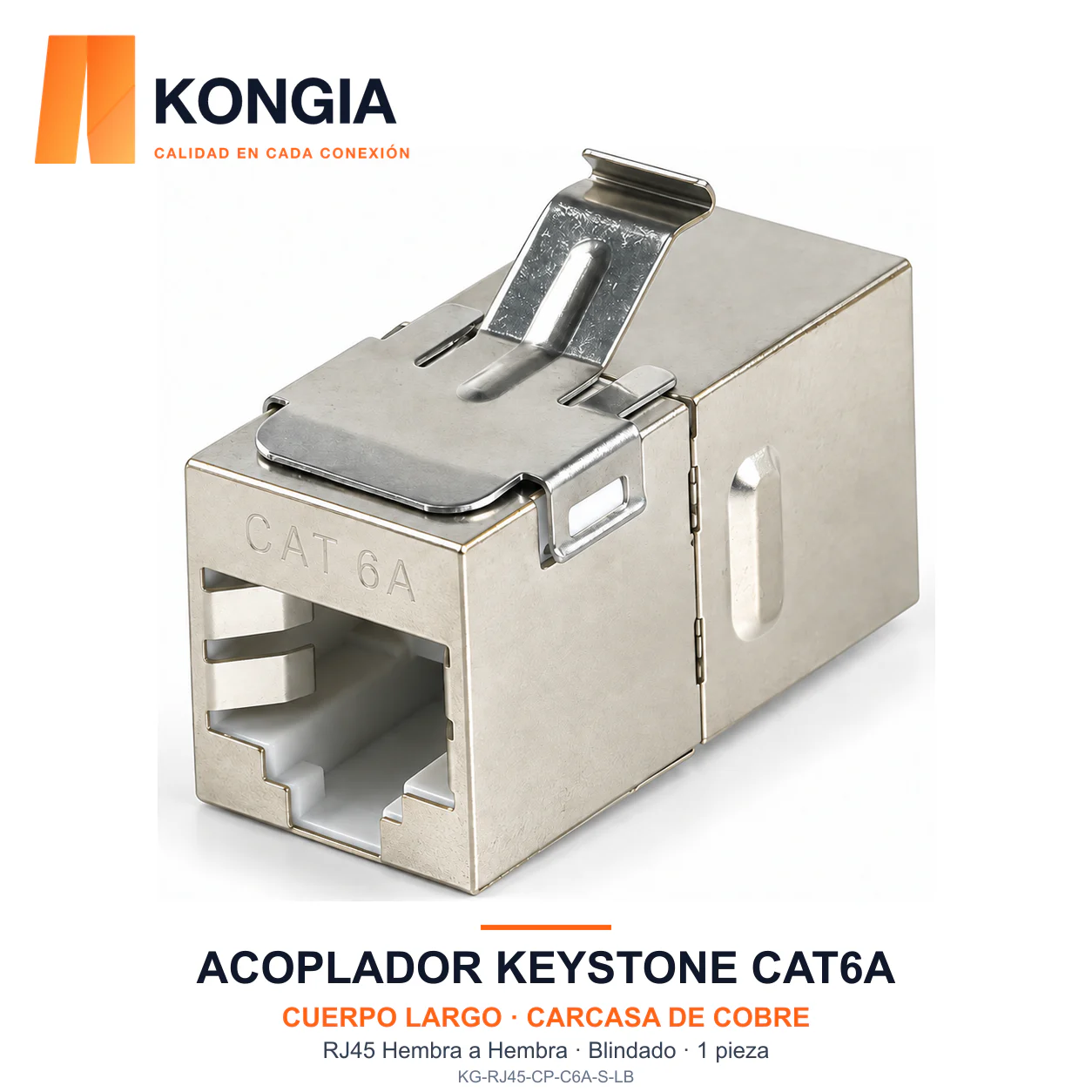
- KONGIA — KG-RJ45-CP-C6A-S-LB
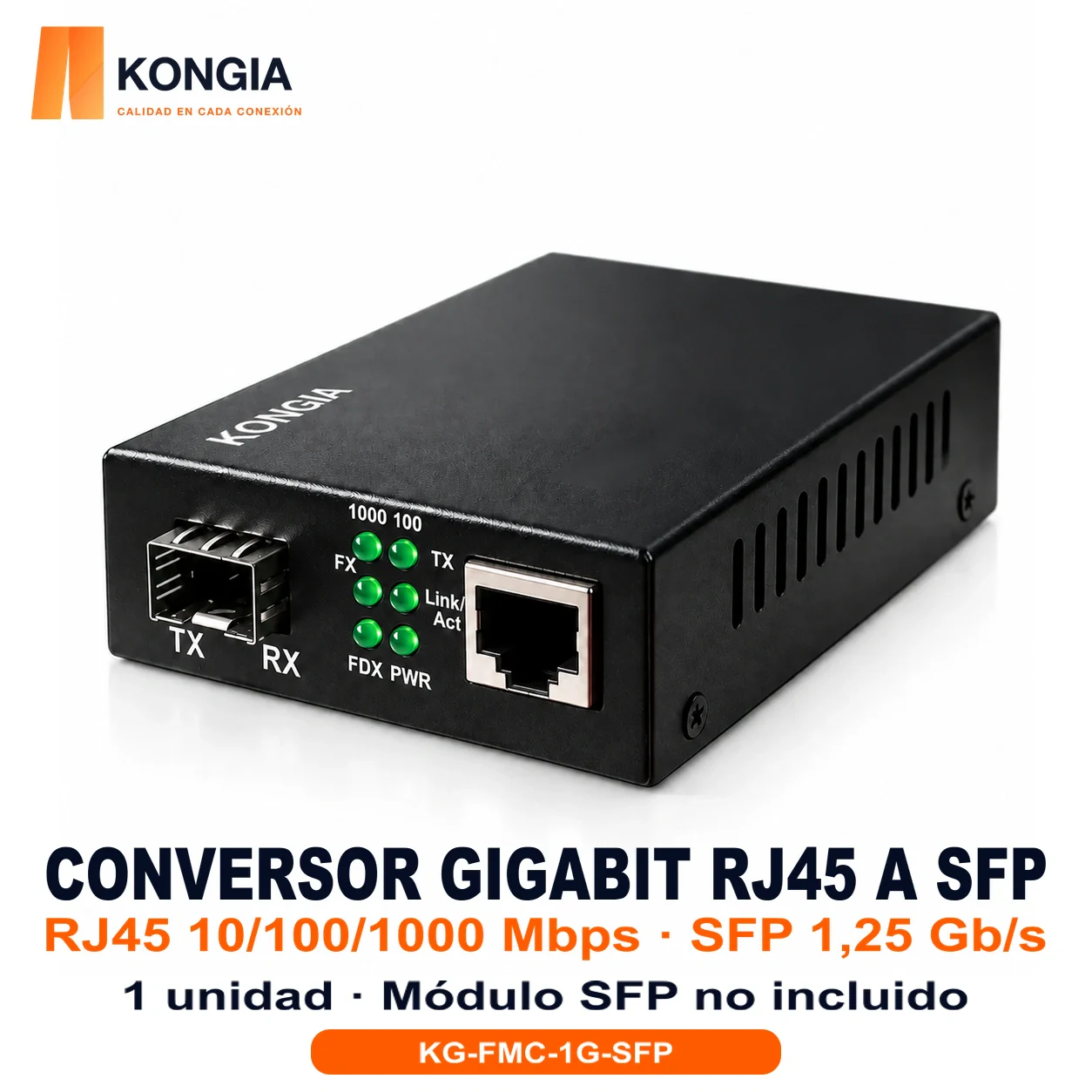
- KONGIA — KG-FMC-1G-SFP
Prepared with AI-assisted drafting from KONGIA-provided company information and the linked product resources. Brand and team statements are company-provided. For a purchasing decision, request current SKU documentation and written commercial terms. Editorial policy